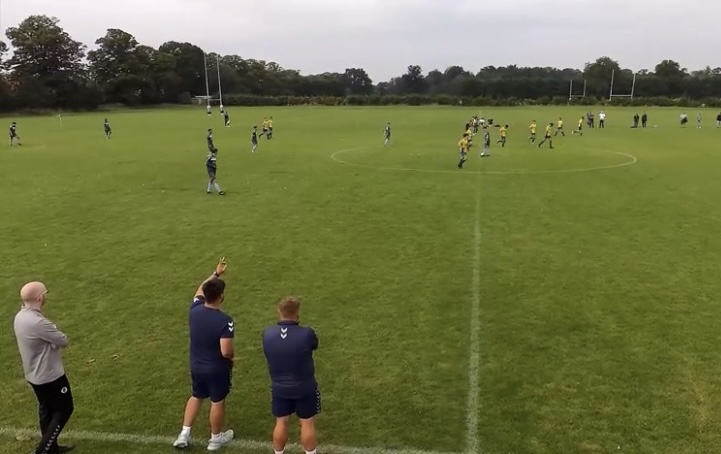
Curriculums have become the foundation and building blocks of all learning and educational institutions in which students, people and players follow to ensure learning and knowledge of topics are formed and developed to a level of understanding. Within a football setting, curriculums and curriculum designs are frequently discussed and highlighted as essential elements of a football team/club. The designing of curriculums can be maniuplated to be used as the implementation of team identity and player development. This blog will explore curriculum design in depth, principles and steps which underpinned curriculum design, context behind the designs and the physical application of curriculum design to impact players and team development.
What is it and what’s the foundations of Curriculum design?
According to literature, curriculum design is a term used to describe the purposeful, deliberate, and systematic organisation of curriculum (instructional blocks) within a class or course (Schweitzer 2019). To any effective curriculum, the design and underpinning factors must be founded through the focus of principles through the means of stages.
Scottish Government (2010) Principles of curriculum design:
> Challenge and enjoyment
> Breadth
> Progression
> Depth
> Personalisation and choice
> Coherence
> Relevance.
Piggott and Lara-Bercial (2015) 3 steps to curriculum design:
•Developing technical, tactical, mental model
•Developing performance model
•Deriving an age and stage curriculum
Rationale
The creation of curriculum provides both coaches and players a set of topics and session that are unique and tailored to that of the team, age group phase and club which consequently can show identity (team and club). Mallett & Lara-Bercial, 2016 and guidance from international bodies (ICCE, ASOIF & LBU, 2013) suggest that ‘developing a vision’ and long-term planning against this vision is a crucial task for head coaches in talent development and performance contexts. Ultimately, a curriculum is the formal structuring of player learning with the fluidity of adaptability and restructure.
Learning
Learning has been defined as relatively permanent change in performance resulting from practice or past experiences Kerr (1968).As a result of these changes, we must take into consideration the importance of the content of our practice and past experiences. What better way to ensure learning takes place than the implementation of a set curriculum? This provides a set programme of topics and skills that will be visited and revisited. I want to highlight the importance of revisiting experiences and practices as both players and coaches can recognise changes both physically and mentally. Skill learning is a continuous and dynamic process. When the learner acquires a skill certain changes can be seen in their performance as they move through stages of learning from a beginner through to a skilled performer. These changes can be analysed in three stages (fittsand poser 1967)
•Cognitive, associative , autonomous
Stage 1 understanding
Stage 2 practicing
Stage 3 maintaining
The ability to retain and transfer learning directly from our training experiences to competitive conditions is vital in performance sport (Fairweather 2006)
Context
Behind any curriculum must be the context of the content that will fulfil the curriculum and what brings the uniqueness of the curriculum to the team or clubs identify of player development. The context behind the content must be driven and informed by the following:
- Mission and Aims of club
- Philosophy of the club
- Game Model – Main Principles
- Game Model Sub principles
The mission of and aims of a club/team refers to the desired outcomes of the environment and setting surrounding the team and the organisation. For an example, the introduction of 4 under 21 players into the first team or helping a player become confident to play a primary and secondary position. The missions and aims should be set as a team or organisation within the inclusivity of the all members. This is to ensure the harmony and cohesion of the group is to strive in the same direction. The philosophy of the team or club is the governance and assurance of the implementation of the missions and aims, this is the everyday rules/laws that will provide the guidance of towards the mission and aims. For an example this could the continuous promotion of under 21’s to join in during first team training, first team staff being integrated into working Under 21’s and creating opportunities for exposure of players into that environment. Additionally, this could also be the continuous focus on players in both training and match situations getting x amount of minutes in a primary and secondary position.
Game Model Main principles refer to the key instrumental components of how the club/team desires to play, ‘their own style’. Additionally, the breakdown of these main principles create sub principles which are micro actions which inform and result in the outcome of the main principles An example of key Main and Sub game model principles:
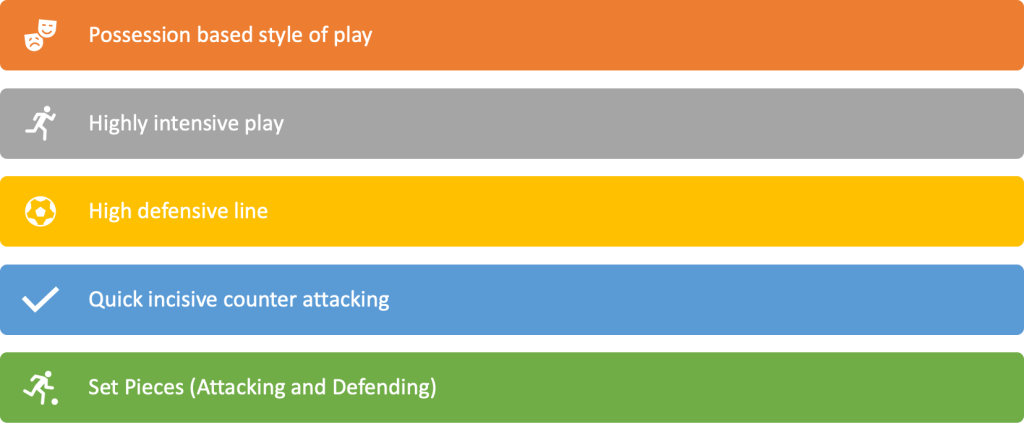
| In Possession | Out of Possession | Positive Transition | Negative Transition |
| Play out of the back | Aggressively press | Play forward quickly | Nearest player to immediately press |
| Play forward quickly | Attacking players to join with with midfield to mid block | Midfield players and full backs to start the counter attacks | 2nd and 3rd players to cover and defensive numerical superiority |
| Retention of possession if unable to go forward | Full backs to prevent attacks in wide areas | Take risks in the final third | If we cannot win the ball back quickly then retreat into compact unit |
| Full backs to over/under lap when attacking wide areas | Compactness of defensive and midfield units | ||
| Play direct plan if the opportunity arises |
Curriculum Types
Spiral
Gibbs (2014) defines spiral curriculum as ‘students revisiting a topic, theme or subject several times throughout a period, where the complexity of the topic is increased with each visit so the new learning is connected to old learning’
Harden (1999) Key features:
•Revisiting a topic multiple times
•Increase in complexity and information given
•Relationship develops between new learning and old learning
Harden (1999) Key Benefits:
•Information is reinforced and solidified each time the student revisits the topic
•Allows for logical progression from simple to complex process
•Players are encourages to reflect upon previous experience and knowledge when producing new knowledge
Developed by Bruner (1960) Spiral curriculum “structured around the great issues, principles and values that a society deems worthy of the continual concerns of its members”
•Allows for elements of the curriculum to be constantly revisited and adapted if required (Son and Simon 2012)
•Allows for players to achieve a deeper understanding of topics over time (Harden 1999)
•Spiral curriculum promotes players to develop their learning through the 3 stages of learning ( Fitts and Poser 1967) at sufficient pace instead of rushing.
•Positive correlation to non-linear pedagogical principles – Non-linear pedagogy found to be more beneficial to player learning than linear pedagogy (Chow et al 2012)
-Constructivism and scaffolding (Vygotsky 1962)
-Greater level of quality of technique and retention of skill (Komar et al 2019)
•Applying a spiral curriculum to coaching will be a similar approach to which the players receive whilst at school.
Block
•International Bureau of Education (2020)defines Block teaching as ‘ set amount of time devoted to a particular topic or prescribed set of learning objectives/outcomes.
Key features: (Marshak 1998)
•Players received intensified knowledge and exposure to a topic
•The players experience a variety of experiences of scenarios within one topic
•Players receive a long period of time to develop a set topic
Key Benefits:
•Coaches focus on breadth and depth within a set topic
•Players allowed adequate time to learn a topic
•Players exposed to learning through different scenarios and experiences
Curriculum Application and Rationale
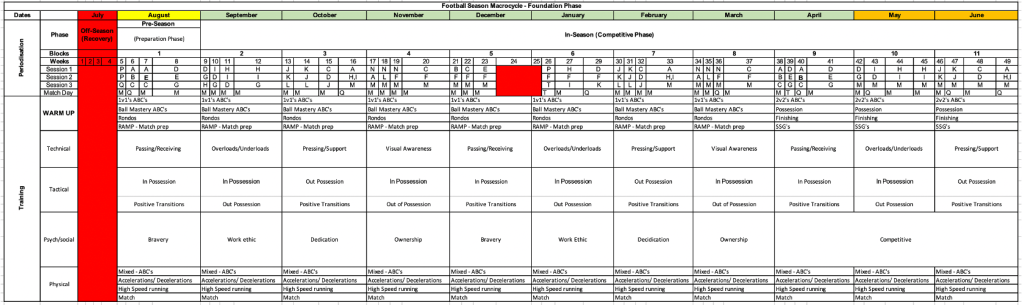
Spiral Macro Cycle
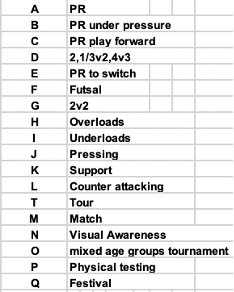
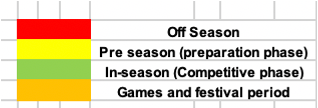
Meso Cycle
| Period: Preparation PhaseBlock: 1 Technical and Tactical focus: Passing and receiving – In possession and Positive transitions | ||||
| Session 1 -Monday – 90 minutes | Session 2 -Thursday- 90 minutes | Session 3 -Friday – 120 minutes – 30 minutes physical development | Matchday – 120 minutes (80-minute game) | |
| Psych/social | Bravery | |||
| Physical | Mixed ABC’s | Acceleration/ Decelerations | High Speed Running | RAMP |
| Week 1 | Physical Testing | Physical Testing | In house mixed tournament | games Programme |
| Week 2 | Passing and receiving – Isolation | Passing and receiving under pressure – opposed | Passing and receiving to play forward – SSG’s | games festival |
| Week 3 | Passing and receiving | Passing and receiving to switch- MDG | Passing and receiving to play forward- SSG’s | games programme |
| Week 4 | 2v1’s,3v2’s. 4v3’s | Passing and receiving to switch | 2v2’s | games programme |
| Period: Competitive PhaseBlock: 11- June Technical and Tactical focus: Pressing/support – Out of possession and positive transitions | ||||
| Session 1 -Monday – 90 minutes | Session 2 -Thursday- 90 minutes | Session 3 -Friday – 120 minutes | Matchday – 120 minutes (80-minute game) | |
| Psych/social | Competitive | |||
| Physical | Mixed ABC’s | Acceleration/ Decelerations | High Speed Running | RAMP- Match |
| Week 1 | Pressing | Support | Match- Friendly | games programme |
| Week 2 | Support | Pressing | Match – In house fixtures | games festival |
| Week 3 | Passing and receiving to play forward | 2v1,3v2,4v3 | Match -in house tournament | games programme |
| Week 4 | Passing and receiving | Overloads and Underloads | Match – Friendly | games festival |
Curriculum Design
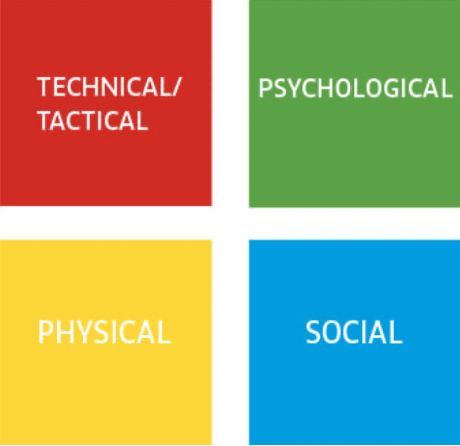
Coaches can use the FA’s Four Corner model to conduct creation of sessions in line with their curriculums. All sessions should have focuses on all four corners, in which each corner is placed on a continuum where certain practices, topics and sessions will hit different levels of focus. As for many coaches within grassroots, the coach must take on a multi disciplinary position within the team with such following roles:
•Coach
•Sports science ( physical performance)
•Medical ( First aider)
•Psychologist
•Performance analysis (reflecting in sessions/matches and reflecting on sessions/matches)
This is no difference in comparison between a macro cycle or a micro cycle (a week or a session). Sessions should have the focus of all areas in which the coach can create sessions with multi possible outcomes not only just technical football learning objectives. Analysing the macro cycle view of the curriculum design, each ‘spiral’ has a technical, tactical, physical, social and psychology focus which is revisited after a period. of time.
of time.
Practice and Coach delivery design
The design of practices and sessions can be used and theoretically supported by using pedagogical principles which actively promotes delivery of curriculum in a non-linear approach through realistic environment and situations. References to support the theories have been added to the key ideas,
- Game based approach – Bunker and Thorpe (1982) – Sampling, representation, exaggeration and tactical complexity = constraints.
•Renshaw et al (2010) Each area can be tailored and adapted to change the outcomes of the practice: Performer, Environment and Learning task
•Renshaw et al (2007) efficient skill development arises when a individual is placed in competitive environment
•Brady and Schollhorn (1998,2009) Constraints led approach – using constraints which varied in contextualised interference and purpose will benefit retention and transfer of learning.
•Problem based Learning – Piaget (1964) cognition theory – Perception, thinking, remembering and problem solving. Interaction with the environment.
•Problem and scenario based learning manipulates the environment in order to provide players with problems to solve and increase holistic development
•Komar (2019) Player ownership and player buy in – Player ownership within learning increases quality and retention of skill.
Through using these key ideas for planning and delivery of the content can be physically implemented through a range of coaching interventions and tools. Such as: Question and answering, Trial and error, Guided discovery and player empowerment. All interventions and tools promote players to have ownership and take moments where coaches can allow players to lead their learning with guidance and support of coaches where and when required.
Conclusion
To bring together this article, curriculum design is the purposeful systematic organisation of instructional blocks of learning within a group. Which is characterised by principles of design and football principles. The characteristics of design focus on challenge, personalisation to the group and individuals which requires variety and deep level learning to ensure quality and retention of learning. The characteristics of football principles which populates the content of the curriculum relies on the missions and aims of the club, philosophy of the club, game model main and sub principles. Curriculums can be formatted into a spiral or block curriculum’s which a-lends themselves to multiply strengths and limitations. With this in mind, this will result in the creation of macro, meso and micro cycles which incorporate the footballing content with focuses upon the FA’s ‘Four Corner’ Model. Finally the delivery of content can be provided through coaches interventions found in a toolbox of styles within an environment which is competitive and realistic to the environment that players are faced with on game day.
 Sempre Avanti Coach
Great piece
LikeLike
Really interesting article, plenty of food for thought to take away from that thank you.
LikeLike
Hi,
Really enjoyed this! Super informative and helpful. Would love to discuss further if possible?
Thanks
LikeLike
Hi Mike, Yeah of course! If you can send me an email at sempreavanticoach@gmail.com, I would be more than happy to discuss with you further!
LikeLike