Something that came into my understanding over the last 4-5 years which I believe to be one of the most underrated, taught and spoken about in all walks of life is Emotional intelligence. Originating from the 1980’s and made famous from Daniel Goleman in the 1990’s, Emotional intelligence can be defined as the ability to identify, assess, and control the emotions of oneself, of others, and of groups. According to Goleman, there are four categories to emotional intelligence:
- Self- awareness
- Self – management
- Social awareness
- Relationship management
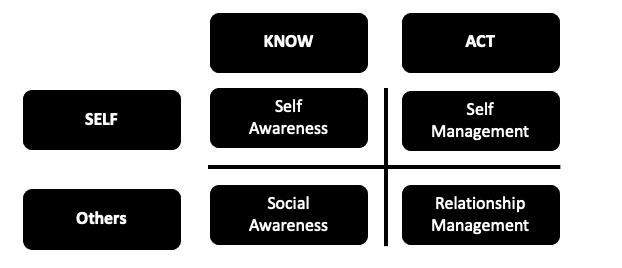
These four categories have been labelled and highlighted as ‘Know’ and ‘Act’, this refers to the understanding and knowing of the emotion and feelings which occur within yourself and others. Whilst Act refers to the behaviour which occurs as a result of how we feel and the emotions we express.
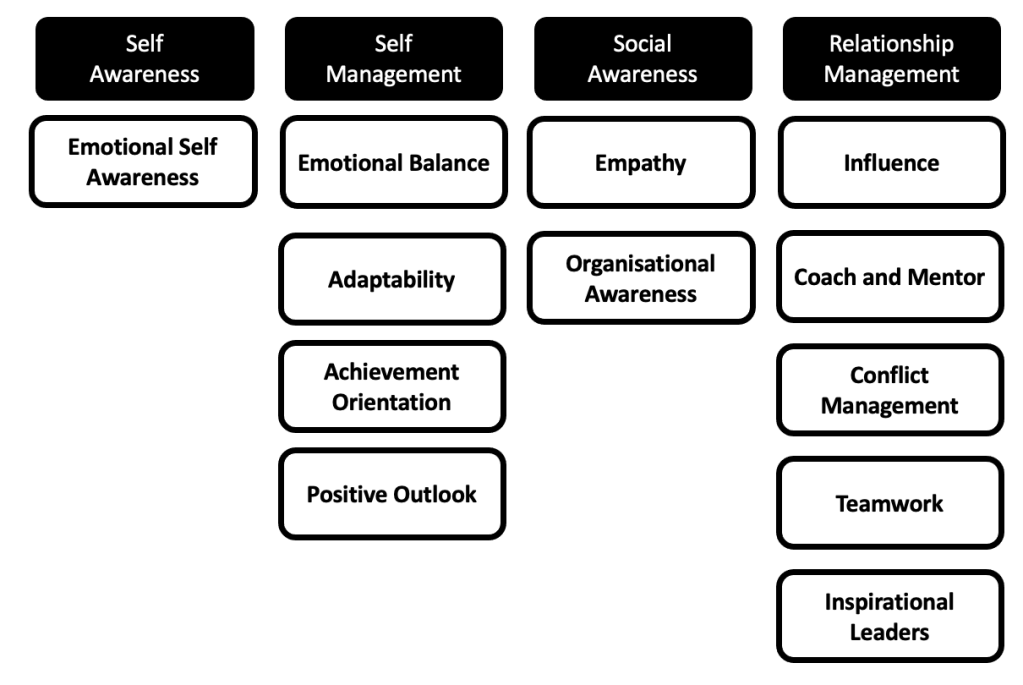
12 competencies image and definitions – https://www.linkedin.com/pulse/twelve-competencies-emotional-intelligence-daniel-goleman/
Emotional Self Awareness is the ability to know your own emotions and their effects on your performance.
Self-Regulate is the ability to keep your disruptive emotions and impulses in check in order to maintain your effectiveness under stressful or even hostile conditions.
Positivity is the ability to see the best in people, situations, and events so you can be persistent in pursuing goals despite setbacks and obstacles.
Achieve means that you strive to meet or exceed a standard of excellence by embracing challenges, taking calculated risks and looking for ways to do things better.
Adaptability means you can stay focused on your goals, but easily adjust how you get there. You remain flexible in the face of change can juggle multiple demands, and are open to new situations, ideas or innovative approaches.
Empathy means you have the ability to sense others’ feelings; have a desire to understand how they see things; and take an active interest in their concerns.
Organizational Awareness is the ability to read a group’s emotional currents and power relationships, identifying influencers, networks, and the dynamics that matter in decision-making.
Influence refers to the ability to have a positive impact on others and meaningfully engage people in order to get buy-in or gain their support.
Coach is the ability to further the learning or development of others by understanding their goals, challenging them, giving them timely feedback, and offering them support.
Inspire is the ability to bring your best and motivate others around a shared mission or purpose in order to get the job done.
Teamwork is the ability to work with others toward a shared goal; build spirit and positive relationships; encourage active participation; and share responsibility and rewards among members of a group.
Conflict Management is the ability to work through tense or highly charged situations by tactfully bringing disagreements into the open, seeking to understand multiple perspectives, and searching for common ground in order to find solutions people can agree to.
So you may ask now what does this mean? Why is this important to me and my coaching? We as coaches are placing ourselves and our players into positions and situations which require decisions -making. These decision-making opportunities will be fed on what we are thinking and feeling plus the environment around us to then correct the best way to act and behave. Players can be faced with up to 6,000 decision making opportunities within a 90 minute game. How can we best create an environment where players are emotionally intelligent and in control to make best of their decisions?
When we talk about EI within sport we must acknowledge the importance and the impact emotions and intelligently using our emotions can have within sport. Sport comes with both highs and low moment which can occur across a session, a match, a week, a term or across a season. This isn’t specifically affecting players but also all staff involved.
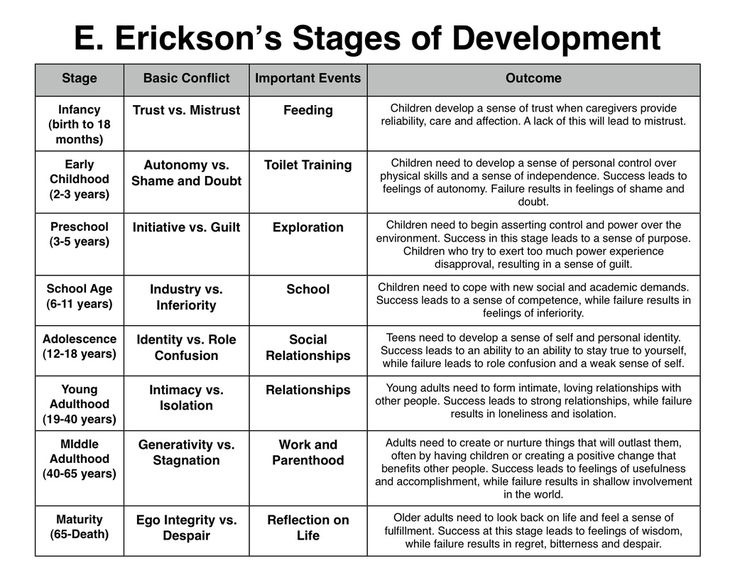
A significant period for players during their youth period is adolescence. During adolescents, young players experience an abundance of changes physically, psychologically and socially. As we can see during ‘Preschool (3-5 years)’ young people are experiencing exploration phrase where they are exploring feelings, emotions, language and purpose. Upon reaching Adolescence, young people are faced with a conflict of identify and role confusion. This outcome creates another opportunity to develop a sense of purpose and identify which can be conflicted by role confusion and understanding of their purpose. A reason behind this is the adaptations and changes which occur in brain growth and progressions. During 12- 18, our Amygdala (emotions) part of our brain is far more powerful than our prefrontal cortex (decision-making) part of our brain, as we come towards the end of adolescence both parts become level and more equal creating a balance. This is due to the Amygdala developing earlier than our prefrontal cortex which comes towards the latter stages of adolescence and young adulthood. The main change that occurs during this period is ‘Pruning’ which refers to the disconnection of unused connections created within the thinking and processing parts of the brain. Whilst most frequently used connections are strengthen and development further with efficiency.
How can we as coaches work on the development of our players emotions intelligence? I appreciate and understand that for a lot of us coaches we are faced with potentially an hour’s training + a game meanwhile some of us are fortunate to have up to 6 hours contact during the week + a game. Either way I believe we all as coaches can have the same impact as long as we focus and plant the same principles to help nurture our players to flourish.
- Understanding and getting to know the player and their worlds both within in sport and outside
- Creating situations/scenarios which require problem solving of different difficulty
- Creating an environment which providing positive but challenging relationships with coach to player and player to player which makes failing acceptable
- Environment rich of ownership and empowerment for players to explore and express
Understanding and getting to know the player and their worlds both within in sport and outside – spending time throughout a session or a week to get to know the players through asking questions allows for the coach to build trust and an relationship in which the coach is invested into the player. This can include, what their hobbies are, favourite team and players, what subjects they are taking at school. This can create situations where players feel more at ease to express their feelings and thoughts about subjects which interest them.
Creating situations/scenarios which require problem solving of different difficulty – Challenging player with scenarios to problem solve can place players under different levels of stress which can create a ‘sink or swim’ situation. Understanding and knowing players as a person and your group, you’ll be able to tailor and know how to scaffold the challenges.
Creating an environment which providing positive but challenging relationships with coach to player and player to player which makes failing acceptable– Creating a culture and a environment which positively supports players when they are struggling or failing to learn or complete a task is essential and promotes psychological safety. Through psychological safety players will feel comfortable and entrusting to talk about their feelings and emotions.
Environment rich of ownership and empowerment for players to explore and express– Placing a focus on a environment full of opportunities for players to be empowered and hold ownership will allow for players to experience decision-making that requires feelings and behaviours to be selected.
We want players to flourish so we must remember the following and how our actions, design of sessions/ environment and delivery can help how:
-We Think
-We Feel
-We Behave
This will help us as coaches help our players ‘Always Forward’ with their emotional intelligence development during youth development.
 Sempre Avanti Coach